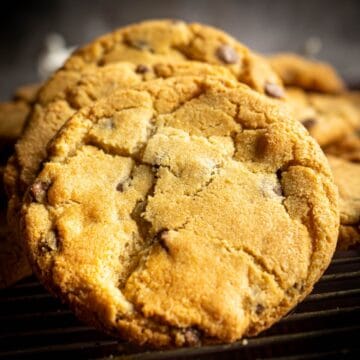
The BEST Chocolate Chip Cookies!
Soft, melt in the mouth PERFECT chocolate chip cookies, crunchy on the outside and chewy inside with caramel undertones and packed with chocolate.
Servings: 14 large cookies
Calories:
Follow at @ellasbetterbakes or tag #ellasbetterbakes!
Alter quantities (metric only) 14 large cookies
Here's what you'll need...
- Small saucepan
- Stand mixer with paddle attachment or hand mixer with beaters fitted
- Baking sheet - a good thick heavy duty one preferably
- Greaseproof paper (parchment paper)
Ingredients you'll need...
- 275 g Plain flour (2¼ Cups of all purpose flour)
- 1 teaspoon Cornflour (cornstarch)
- 1 teaspoon Bicarbonate of soda (baking soda)
- ½ teaspoon Baking powder
- ¼ teaspoon Fine salt
- 100 g Unsalted butter (cut into small pieces) must be cold (7 tablespoons)
- 85 g Unsalted butter (cut into small pieces) (⅓ Cup), you should have 60 grams (¼ Cup) of left once browned
- 125 g Caster sugar (10 tablespoons of superfine sugar)
- 165 g Light brown sugar (¾ Cup , loosely packed)
- 1 Large egg without the shell it needs to weigh 60 grams, must be at room temperature
- 1 Egg yolk at room temperature
- 180 g Milk Chocolate Chips (1 Cup and 2 tablespoons)
Here's what we do...
- Sift your plain flour, cornflour, bicarbonate of soda, baking powder and salt together and set aside.
- Place your 100 grams of cold butter into your mixing bowl and fit the paddle attachment (or beaters if using a hand mixer).
- Over a medium-low heat, gently melt your 85 grams of butter in your small saucepan.
- Turn up the heat to medium-high. The butter will soon start to simmer. Keep stirring and scraping the bits off the base. The butter will soon become frothy, and then brown flecks of milk solids will settle on the base of the pan. Soon after, the butter will develop a nutty aroma and turn a deep golden brown. It usually takes about 4 minutes from when the butter started simmering until when it has browned.
- Once browned, remove the pan from the heat and immediately weigh out 60 grams (¼ Cup). Make sure you scrape the brown bits from the base and include them as they are full of flavour.
- Pour the 60 grams of your browned butter over the butter waiting in your mixing bowl and then immediately beat the butters together for 2 minutes on a medium high setting. If there are a few lumps of butter remaining, that is fine.
- Tip both sugars over your butter and beat for a minute on low setting, then turn up to a medium high setting and beat for another minute. Wipe the bowl down with your spatula midway to be sure everything mixes evenly. The mixture is ready when it is soft and creamy, light brown in colour and sticking to the edges of the bowl, not the paddle or beaters.
- Beat your eggs together and then tip them into the butter mixture, along with a dessert spoonful of the sifted flour mixture. Beat on a low speed until all of the egg has been incorporated. This takes about 10 seconds. Then beat on high for 10 seconds until creamy.
- Dump in all of the remaining flour mixture and beat it in for 10 seconds on a low setting.
- Add your chocolate drops and again beat in very briefly, for only about 5 seconds, just to disperse them.
- Gently bring the cookie dough together into a ball by hand.
- Roll the cookie dough into equal balls. Mine weigh about 67-68 grams each.
- Set your cookies on a baking tray or plate and then cover them with cling film (plastic wrap) and refridgerate them for at least 6 hours. Overnight is even better.
- When you are ready to bake your cookies, heat your oven to 170℃ Fan/190℃/375℉/Gas mark 5.
- Line your large baking sheet with greaseproof paper.
- Place your cookie balls about 3 inches apart from each other. You will likely need two trays or need to bake in 2 batches.
- After 13-15 minutes your cookies should be just golden around the outside but look a bit undone in the middle. That is perfect. Remove the tray from the oven and leave them on the tray to continue to cook for 10 minutes.
- After 10 minutes remove the now set cookies from the trays onto a cooling rack to fully cool.
- Enjoy! They are irresistible!
Make sure your bicarb and baking powder are in date. If out of date. it can affect the quality of your cookies (and any bakes they are used in, for that matter).
Don't worry too much about whether the butter is not browned enough. As long as it has turned golden and the bits are on the base, it will be fine. Better than burning it, and it will still have lots of flavour!
Overbeating your cookies, once the flour has been added, will make them tough; therefore, keep mixing to a minimum from this point onwards.
Allowing your cookie dough a good amount of time in the fridge helps the dough to develop a deeper flavour and gives the gluten in the flour time to relax. This is really crucial to get the perfect baked cookie.
The middle of your oven can be a different temperature from the lower and upper levels. Investing in an oven thermometer and putting it on the shelf you need to use will help you to accurate gauge the temperature of that part of the oven.
If your cookies have spread too much or are not as circular as you'd like them, just use a spatula to gently push the edges back into an even shape. This must be done as soon as they come out of the oven and are still nice and soft.
Supporting Notes
You can use this cookie recipe as the base for whatever flavour of cookies you want to make. Simply swap the milk chocolate chips out for the filling of your choice.
See blog post for guidance on using this recipe to make loaded cookies.